
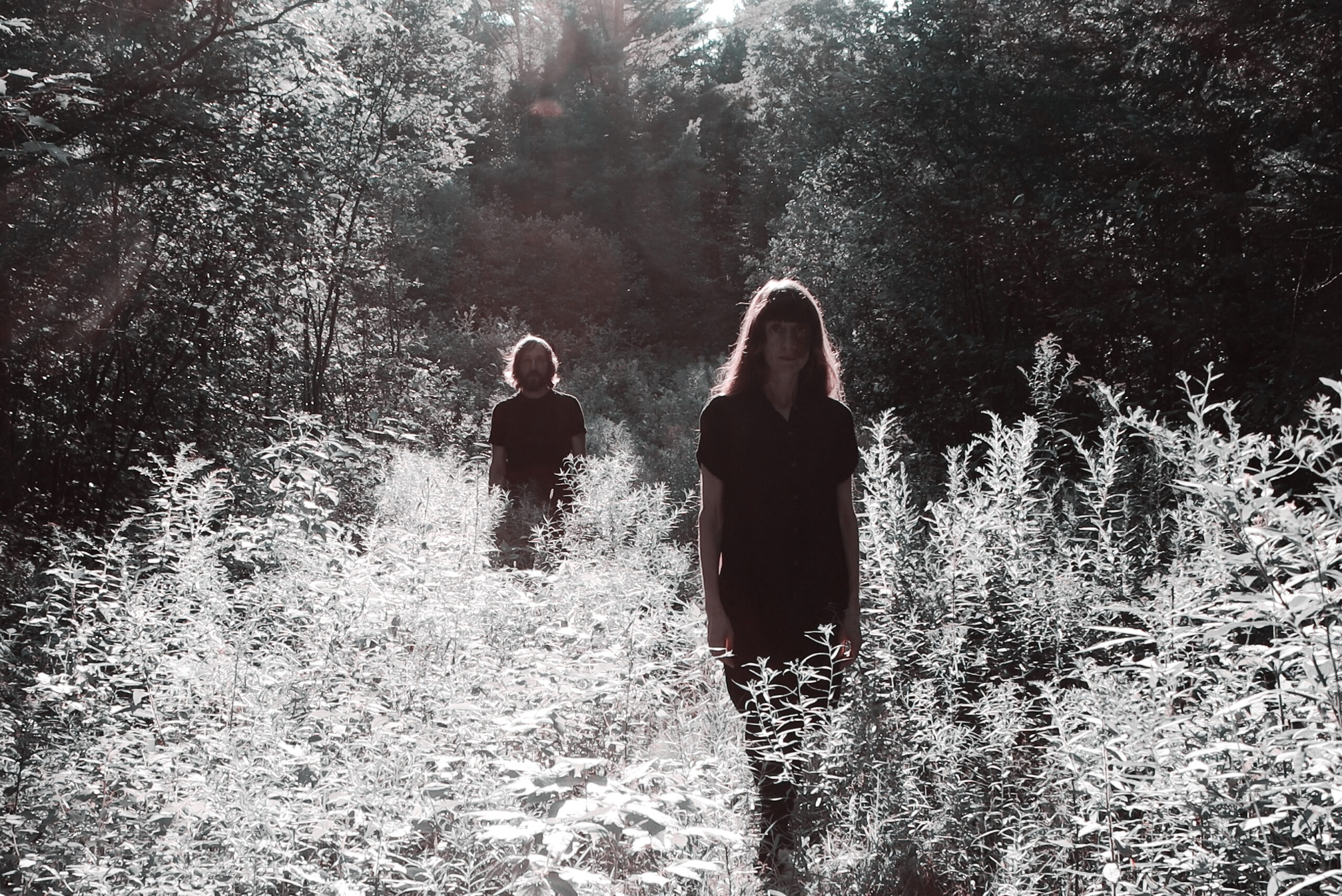
Menace Ruine (Geneviève Beaulieu and S. de la Moth, Montreal, Quebec) began in 2006, releasing their first full-length album, Cult of Ruins, in 2008 on Alien8 Recordings, which was one of the standout labels of that era until it folded in the early 2010s. Soon after, they followed up with The Die Is Cast. While Cult of Ruins delivers an intense, noise-driven black metal assault akin to the work of Wold, The Die Is Cast reinvents that raw sound into a dense, droning magma, over which Geneviève sings with a strikingly hieratic presence. As you’ll see in the interview that follows—conducted ahead of their rare appearance at Amplifest—it’s tempting to compare Geneviève’s approach to Nico, while the music itself recalls the wave of experimental drone metal projects that emerged during that period. Groups like KTL and Wold explored the atmospheric and noise aspects of black metal, a path pioneered in the ’90s by artists like Burzum, shifting the focus away from traditional songwriting.
In 2011, Union of Irreconcilables was released on Aurora Borealis, another label renowned for straddling the fringes of extreme genres. Then came Alight in Ashes and Venus Armata, both on Profound Lore—a label with a strong metal foundation but known for its adventurous, non-traditionalist edge. From The Die Is Cast onward, Menace Ruine’s sound has remained consistently distinctive yet never repetitive, partly because of the duo’s low-profile approach. They eventually moved away from Montreal to immerse themselves in a more nature-centered life, aligning with their long-standing veganism and dedication to animal rights. Their releases are infrequent, with Nekyia—self-produced and released eight years after Venus Armata—only now hitting shelves. Interestingly, Venus Armata has also been reissued with the sound the band originally envisioned for it back in 2014.
Nekyia once again evokes a timeless, mystical quality, blending distorted drones with Geneviève’s haunting vocals and carrying a subtle medieval and folk undertone. I followed Menace Ruine’s journey for years, but somewhere along the way, I lost track of them—a misstep I’m trying to make up for with this interview.
—
I know you because of a record label called Alien8 Recordings. Incredible times: in that period, they discovered Nadja, Tim Hecker, Sam Shalabi… Please, share with us a simple memory of that label and of your beginnings.
Geneviève Beaulieu: We hold the early days of Menace Ruine close to our heart and are grateful to Gary and Sean at Alien8 Recordings for their interest in us. Gary, who is both open-minded and deeply immersed in dark music beyond genres, recognized something unique in our in-between, shape-shifting sound. He was the first to play our music on his radio show and invited us to perform live in Montreal. Back then, we played in Montreal a few times each year. Alien8 organized monthly “dark” showcases, and while we were never particularly drawn to shows, we got to perform alongside acts like Nadja, Daniel Menche, and other artists from the A8 community, as well as other curious noise projects around Montreal. It was a fun time, and friendships naturally grew from it. Though we left Montreal a decade ago, it’s always a pleasure to see Gary at his Cheap Thrills record store. Those years remain foundational for us.
Second curiosity (twenty years old curiosity, I would say): how did you find the monicker “Menace Ruine”?
An old curiosity indeed! We brainstormed names, scribbling ideas on scraps of paper and tossing them into a bowl. Menace Ruine, one of the names I came up with—though I can’t quite recall how or why—ultimately won. Being French Canadians, Steve and I appreciated that it was meaningful in both French and English, or at least evoked something similar. There’s a poetic strength to it that just fits the “apocalyptic” edge of our music and lyrics. In a way, it also foreshadowed the precarious nature of our musical path, always on the edge of collapse… like the world itself, and like us within it.
One thing that still fascinates me is the shift between Cult of Ruins and The Die Is Cast. What is happened between 2007 and 2008?
When listening to our first release, In Vulva Infernum (the CD-R demo), one can hear a lot of the foundational elements already there. It’s a mix of noise, black metal elements, and even a doom piece, “In Reverse We Die,” which I did as a tribute to Blue Cheer after catching them live at CBGB in NYC. There were also more melodic, vocal-driven tracks like “Dark Mother” and “Permanently Liminal,” leaning closer to the style of The Die is Cast.
Gary played a certain role in orienting the direction of Cult of Ruins—with its noisier/black metalish sound—for release on Alien8 Recordings. He insisted on including the track ‘Bonded by Wyrd’, originally from the CD-R, while we decided to remove ‘Feu Bon,’ keeping only the final part of it, ‘Atavism’. By then, though, I’d already started working on the songs for The Die is Cast, using lyrics I had written during the previous albums. It’s always easier for me to compose when I have existing lyrics to guide me. The creative process was almost magical; everything seemed to fall into place on its own. Singing over those dense, fuzzy sounds felt inspiring, almost like a subconscious way of restoring balance. Gradually, we leaned more and more into that direction. When we pitched The Die Is Cast to Alien8 not long after Cult of Ruins, we felt confident even though it was very different, and they released it in 2008 as well.
Is there a red thread that goes from The Velvet Underground, through Nico, Swans, and reaches you? Not the only thread possible with you, but one of them, in my opinion.
I can see how you might draw a link between Nico and The Velvet Underground, but S. and I have never really been into Swans, so that connection feels unlikely.
Nekyia contains beautiful material. In many cases, I thought, ‘They are aging like fine wine.’ ‘Umbra Horrenda’ and ‘One Last Song’ are like the work of an artisan who really knows his craft. Especially, I’m fascinated by the lyrics of ‘Umbra Horrenda’: are you praying for our extinction?
It is more about crying for all the victims of human kind, and hoping that we can repair the harm we have done. Do we really believe it is possible? Not that much… though there are good souls among us. We have very little faith in humanity, and we’ve gone too far into the shadow side of things. We witness wars of the most evil kinds, natural disasters, the extinction of countless species, and destruction all over the Earth. Our “horrendous shadow” has leaked into our world and is now engulfing us. There’s no bright future ahead if there’s only a future at all.
This song is about our collective shadow but also about resilience. The character who initially inspired it—beautiful Oliver, a bear rescued by Animal Asia—spent 30 years caged in a Chinese bear bile farm. After his rescue, he enjoyed four borrowed happy years in their sanctuary, yet he seemed to have forgiven humans for the hell he suffered. Without praying for it, we can’t help but feel that our extinction might provide a much-needed reprieve for this planet, allowing nature and other animals to regenerate.
Geneviève published a solo album. I’ve read that the story of this album goes back to 2011-12. It seems that you, as artists, have a different perception of time. Today, everything ages very quickly. You seem not to care at all. For me 2011 is a century ago. For you?
In 2011, I was deeply immersed in Menace Ruine and Preterite, so this burst of inspiration caught me off guard, and I couldn’t fully engage with it at the time. I have no problem letting material rest until its moment arrives, especially when that material feels timeless and unfashionable. However, something strange happened after we released Venus Armata in 2014 and moved into the woods. There’s a gap in time that I find difficult to explain. While I feel very present in the moment, I later realized that so many years had passed without me truly feeling it. Time is largely a matter of perception, and I believe this becomes even more pronounced as we age. I really don’t worry about it. What matters is that each thing arrives when it’s ready, free from external pressure, but above all, when it feels right.
Your new albums are out on your imprint, Union Finale. You have also reissued your 2014 album, Venus Armata. Now you have complete control of your work. I suppose this is more important to you than having more visibility on an established label. Am I wrong?
We decided to reissue Venus Armata because we were never fully satisfied with the sound of the 2014 version. With our skills having improved, we took the opportunity to remix it and worked with Gus Elg on the mastering, as he did outstanding work on Nekyia. Now, it sounds as it was always meant to. Releasing our albums on Union Finale isn’t so much about controlling the artistic aspect of our ‘work’ as it is about the freedom to choose our own pace, avoid things we’d rather not do, and manage projects on our terms.
That said, we didn’t feel much pressure from any of the labels we’ve worked with and still have positive memories of them. However, since our music doesn’t fit neatly into a single genre, finding a true home for it has been challenging. For example, we had a great experience with Chris Bruni at Profound Lore—he’s a true professional, very open-minded, and he treated us very well—but it ended up pigeonholing us a bit within the metal scene. While some metal fans may connect with our music, we aren’t “metal” enough (if at all) for most of that audience. We appreciate metal, of course, but being labeled as such didn’t really serve our music.
We handle almost everything ourselves, from recording and mixing to artwork and design, and we rarely perform live. So, releasing our music independently felt like a natural step. We also value the direct contact with people who buy our albums, though greater visibility would certainly be welcome. Perhaps one day, we’ll find a better home for our music or a way to collaborate with a larger label to help it reach more people.
It’s not so easy to see you live. Why at Amplifest?
It’s such a wonderful festival, with a friendly, family-like vibe. We had a fantastic experience in Portugal back in 2011 with André from Amplificasom, though we never had the chance to play at Amplifest. He’s incredibly kind and respectful toward both the artists and the audience. It was bold of him to invite us to perform at the 2024 edition, especially since we had intended our 2015 show at LUFF to be our last performance ever. He was very persuasive, and we just couldn’t say no.
The timing worked out well, too, as we had already been considering a show in Montreal around the same period, at the Cinémathèque Québécoise—another wonderful invitation we received several months ago. So, we decided to do both. And there’s one more thing that helped us make the decision: I’ll be turning 50 the weekend of Amplifest. It’s going to be a memorable birthday.